
An agent is an autonomous software system that uses an LLM to reason about a goal, call tools, and run multi-step actions until the task is done: plan → act → observe → adapt → deliver.
Think of it as a new kind of computer:
| Classic computer | Agent |
|---|---|
| CPU | LLM |
| RAM | Context window |
| Peripherals | Tools |
| OS | Agent harness |
| Application | Agent |
The LLM is superhuman at knowledge, language, and code, but weak at persistent memory, hallucination, and adversarial input. The rest of the system exists to cover those weaknesses.
The stack (layers)
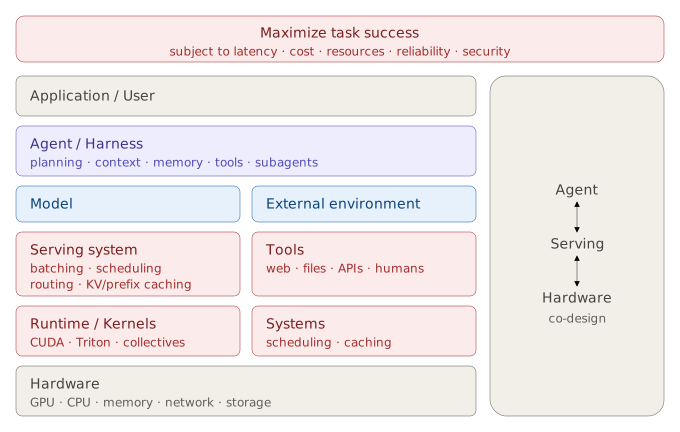
| Layer | Holds | Remember it as |
|---|---|---|
| Application / User | The task and its owner | the goal |
| Agent / Harness | planning · context · memory · tools · subagents | the OS |
| Model | The LLM | the CPU |
| Serving system | batching · scheduling · routing · KV/prefix caching | the scheduler |
| Runtime / Kernels | CUDA · Triton · collectives | the drivers |
| Hardware | GPU · CPU · memory · network · storage | the machine |
| External environment | Tools: web · files · APIs · humans | the world |
Two halves:
- Agent (top): decides what to do.
- Serving + hardware (bottom): decides how fast and how cheap.
The best gains come from co-design across the halves, for example a harness that keeps its prompt prefix stable so the serving layer can cache it.
What to optimize. Not tokens per second. The objective is:
maximize task success, subject to latency, cost, resources, reliability, security
Measure $ per successful task and end-to-end latency, not GPU utilization.
Logical components (inside one agent)
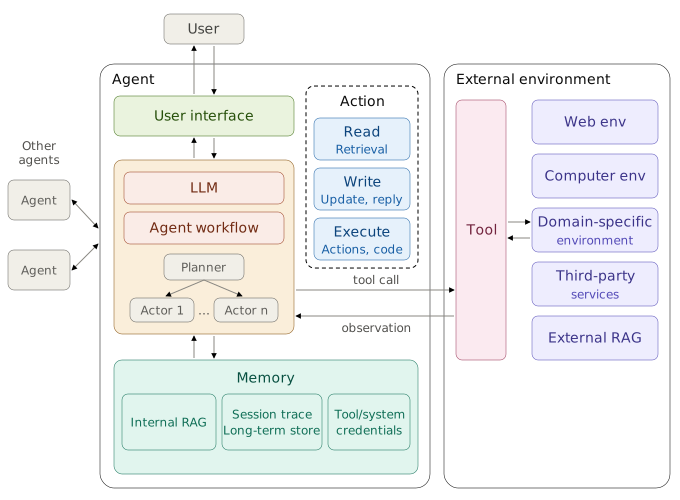
| Component | Job | Detail |
|---|---|---|
| LLM | The brain | One or several models, each with a role |
| Workflow | The control flow | A planner splits the task; actors execute the steps |
| Memory | What it remembers | Session trace · long-term store · internal RAG |
| Tools | The hands | Three kinds of action: read, write, execute |
| Environment | Where it acts | Web · computer · domain-specific · third-party services · external RAG · other agents |
| User interface | How people talk to it | Text, previews, interactive elements |
The loop: the LLM picks a tool call → the environment returns an observation → repeat.
Agents differ from traditional software in two ways:
- They mix AI models with ordinary code.
- Their workflow is generated at runtime, not written in advance.
Why agents are a systems problem
Plain LLM serving is one hop: request → inference → response. An agent is a chain: infer → tool → infer → tool → retrieval → infer…. The critical path crosses GPU, CPU, storage, network, and outside services.
| Workload property | Systems problem |
|---|---|
| Long trajectories | State and context management |
| Repeated prefixes | Prefix caching |
| Tool dependencies | Dependency-aware scheduling |
| Variable tool latency | Asynchronous execution |
| Multiple agents | Orchestration and communication |
| Huge context | Memory hierarchy and retrieval |
| Branching reasoning | Speculative execution |
| Different models | Routing |
| External side effects | Security and isolation |
| Long-running tasks | Checkpointing and fault tolerance |
Observability is first-class: a trace becomes a nested trajectory (session → turn → agent step → model request → tool call → result → subagent). You cannot optimize what you cannot observe.
Flexibility is risk
The SoK paper rates an agent on seven independent dimensions. Each goes from least to most flexible, and every step up adds capability and attack surface.
| Dimension | Least flexible | Most flexible |
|---|---|---|
| Input trust | No external data | Arbitrary external data |
| Access sensitivity | No sensitive data | Arbitrary sensitive data |
| Workflow | Simple chatbot | LLM-defined, dynamic |
| Action | Response only | Response + retrieval + execution |
| Memory | None | Persistent across sessions |
| Tool | None | Arbitrary tools |
| User interface | Text only | Interactive web elements |
Three attacker types:
- External: controls only content the agent reads, such as web pages or documents (indirect prompt injection, tool poisoning).
- User-level: talks to the agent directly (direct prompt injection).
- Internal: a malicious developer or tool provider.
Three defense principles:
- Defense in depth: guardrails, information-flow control, monitoring, human approval, and hardening, layered together.
- Least privilege: each task gets only the tools it needs.
- Complete mediation: check every access to a sensitive resource.
Cheat sheet
- An agent is LLM + context + tools + harness, a new kind of computer.
- Top half decides, bottom half serves; optimize them together.
- Components: LLM, workflow, memory, tools, environment, UI.
- Tools do three things: read, write, execute.
- Optimize $ per successful task, not tokens per second.
- More flexibility means more risk. Apply least privilege.
For a full worked design, see Designing an Always-on Agent.