
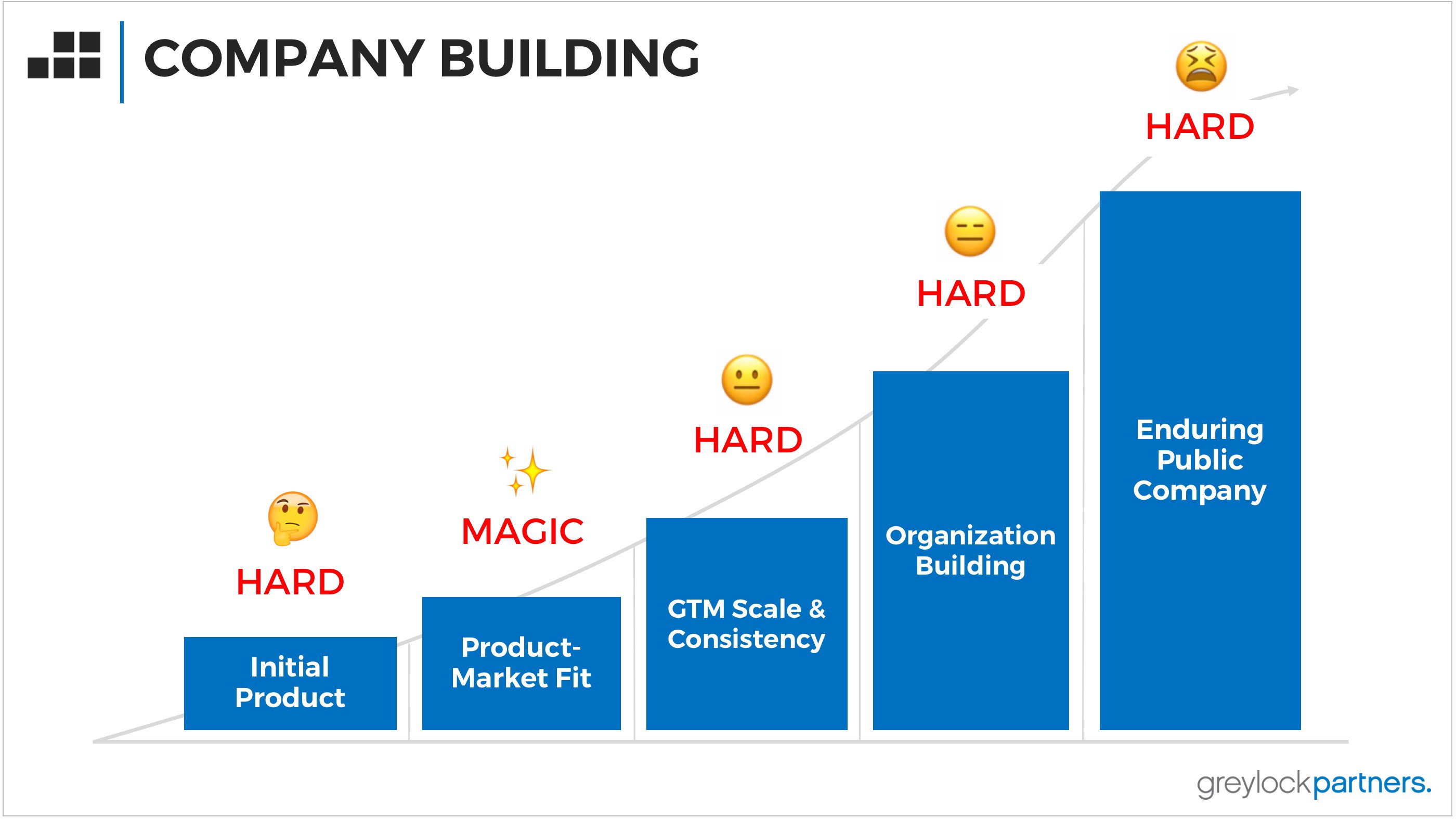
Sarah Guo's framework from Greylock compresses company-building into five stages. The framework's value isn't the list — it's that each stage has a different primary job, a different set of metrics that matter, and a different failure mode. Most companies don't die from executing stage N poorly. They die from trying to do stage N+1 while they're still in stage N, or from refusing to let go of stage N-1 when the real work has moved on.
1. Build and ship the product
The work is turning a hypothesis about a customer problem into something a real person can use. The only metric that matters is whether the thing works end-to-end for at least one real user doing a real task.
Primary job: Get to a daily-useful artifact. Hiring bar: Founding engineers who ship and founding PMs who talk to customers weekly. Failure mode: Over-engineering for scale you don't have. Building a platform before you have a product. Signal you're done: At least a handful of users are using the product voluntarily and would complain if it broke.
2. Find product-market fit
The hardest stage, and the one most companies die in. PMF isn't a point; it's a transition from "we have to push the product onto customers" to "we can't keep up with demand." The signs are qualitative before they're quantitative: unprompted word of mouth, customers getting angry when the product breaks, a small but real cohort that retains at 6 months.
Primary job: Iterate on product and positioning until the demand pull is obvious. Hiring bar: Keep the team small. Every new hire slows iteration during this stage. Failure mode: Spending on growth (paid ads, sales team) to manufacture metrics that look like PMF. This is the most expensive mistake in startups — you end up with a bigger org around a product that doesn't pull. Signal you're done: Retention curves flatten rather than decay to zero. Customers refer other customers without prompting. You have more demand than you can serve.
3. GTM scale and consistency
Once pull is established, the job is making the pull repeatable. This means going-to-market through channels that scale predictably — a sales motion with a measurable CAC, a growth loop with measurable K-factor, a content engine with measurable pipeline. This is where you start caring about unit economics (LTV/CAC, payback period) as first-class metrics.
Primary job: Build at least one growth channel with predictable CAC and positive unit economics. Hiring bar: First GTM leaders — head of sales, head of marketing, head of growth. Look for builders, not operators; the playbooks don't exist yet. Failure mode: Scaling on channels that don't have positive unit economics ("we'll fix it at volume" — you won't). Adding GTM hires faster than the system can onboard them. Signal you're done: Revenue grows predictably quarter over quarter. You can forecast next quarter's number within ~10%.
4. Organization building
At this stage the founder's IC contribution matters less than the founder's ability to build an organization that runs without them. The job shifts from "ship the feature" to "build the team that ships the feature." Process, culture, leveling, hiring bars, communication rituals — all of the stuff founders typically resent — become the actual work.
Primary job: Build an executive team that can run functions independently. Create systems (planning, hiring, performance) that scale past the founder. Hiring bar: Executive hires with scale experience. The first five are bet-the-company decisions; a bad VP Eng or VP Sales at this stage can take 18 months to detect and cost a full year of progress. Failure mode: Founders who keep operating at the IC layer ("I'll just write this spec myself") and starve the exec layer of real decision authority. The reverse also happens: founders who disengage too fast and lose the product instinct that got them there. Signal you're done: The company ships multiple large initiatives in parallel without the founder as a dependency. The exec team runs weekly ops without the founder's attendance.
5. Enduring public company
IPO is a liquidity event, not a finish line. The work of the public-company stage is managing a portfolio of bets — core, adjacent, transformational — while meeting quarterly obligations to public shareholders. The failure mode at this stage is usually one of two things: optimizing the core to the point of stagnation, or spending on adjacencies so aggressively that the core weakens.
Primary job: Balance the core business (stable, margin-producing) against new bets (growth, optionality). Maintain the culture that made the company successful while professionalizing the functions that must scale. Hiring bar: Proven operators who can manage public-company scrutiny. At this stage, "I've done it before" is a feature, not a bug. Failure mode: Innovator's dilemma. Inability to cannibalize your own product. Loss of founder intensity in exchange for professional polish. Signal you're done: You either keep compounding (rare) or a new generation of founders inside the company carries the next S-curve.
Why the model is useful
Three things this framework gets right, which are worth keeping even if you swap out the specific stage names:
- Each stage has its own success metric. Stage 2 is retention; stage 3 is payback period; stage 4 is exec leverage. Using stage-3 metrics in stage 2 (or vice versa) leads to the wrong decisions.
- The transitions are where companies die. The cultural norms that got you through stage 2 (heroic effort, low process, founder in every decision) actively poison stage 4. Leaders who can't make the transition get replaced or hollow out the business.
- The hiring bar shifts between stages. A great stage-2 PM is often a mediocre stage-4 PM, and vice versa. The same person can grow into both, but you can't assume it.
See also
- 9x Effect — why new products need to be dramatically better to win, relevant to stage 1-2.
- Hierarchy of Engagement — Sarah Tavel's framing on retention, relevant to stage 2 PMF.
- OKR Template — goal-setting tool used heaviest in stages 3-4.
- Good to Great — Jim Collins on the stage-4 to stage-5 transition.